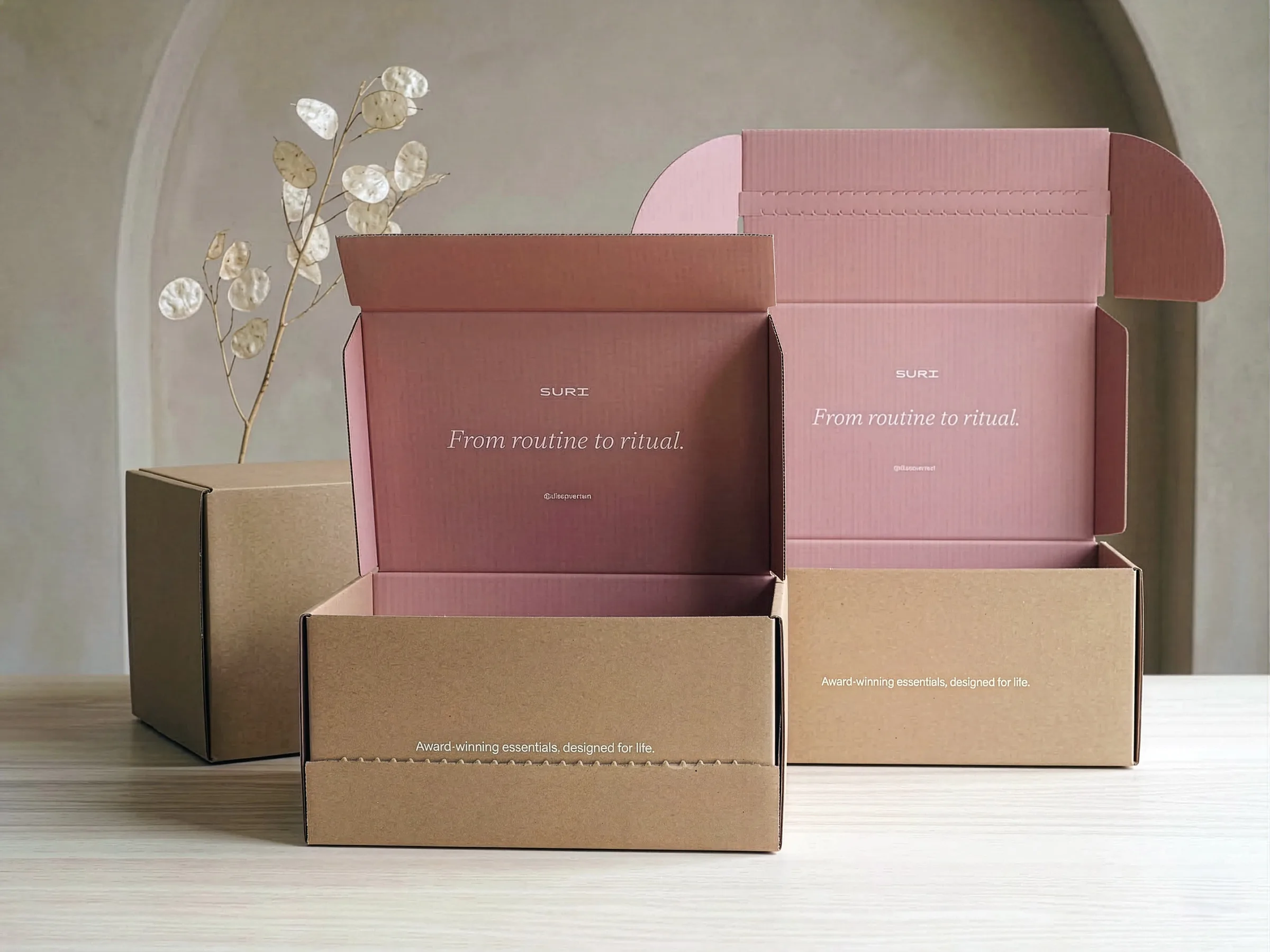
This is the first in a five-part blog series called 25 Ways to Save Money on Packaging, published every Wednesday. Each week, we’ll explore a different area of packaging strategy, from smarter design and efficient fulfilment to procurement hacks and logistics – all tailored to help brands like yours cut costs while maintaining a great customer experience.
Blog 1: The Art of Smarter Packaging Design
Packaging isn’t just about looks. It’s about efficiency, cost, and practicality. In this post, we dive into 10 clever strategies to reduce packaging spend through better design.
1. Use fewer components
Printed extras like booklets, product guides, and thank-you cards might seem small but they drive up costs in printing, assembly time, and materials. Every extra item that needs to be printed, sourced, and packed adds time and complexity to your fulfilment process. Streamlining these components or shifting them to digital via QR codes, onboarding emails, or printed messages inside the box, can significantly reduce overheads without losing the customer touch. Sonos did just that by digitising their legal insert, saving $640,000 annually and eliminating 200,000 pounds of printed paper. It’s a win for the environment, and a major win for cost.
2. Ship less air
Oversized packaging not only increases shipping costs but also creates a poor customer experience. Bulky boxes filled with void fill are frustrating to receive and inefficient to store and ship. Right-sizing your packaging helps reduce both material waste and shipping fees. IKEA halved the package size for its Ektorp sofa by redesigning it to be flat-packed — saving costs across storage, transport, and emissions. In the UK, brands like Trinny London use compact, tailored packaging for their stackable beauty products, ensuring every inch of space is used efficiently while still protecting the contents. Less air means less cost, and a lot less frustration for the end customer.
3. Reduce thickness and strength
Packaging doesn’t always need to be heavy-duty. For lighter items like clothing, cosmetics, or accessories, switching from double-walled corrugate to single-wall E-flute can cut costs significantly without affecting performance, or even a mailer bag. These thinner materials reduce both raw material usage and overall package weight, which means cheaper shipping and lower carbon impact. They also take up less space in storage and are easier to handle during fulfilment. The goal is to match strength to need and avoid over-engineering where it isn’t necessary.
4. Reduce product volume
Smaller products lead to smaller packaging and lower costs across the board. If your product can be reformulated to be more concentrated, or redesigned to be flatter or modular, the packaging that surrounds it becomes instantly more efficient. Walmart saved massively by switching to concentrated detergent, shrinking the footprint and weight of each bottle. In the UK, Smol took this further with compact, letterbox-friendly laundry capsules that reduce courier costs and eliminate the need for outer packaging entirely. Every centimetre you shave off product size reduces costs in materials, shipping, storage, and emissions.
5. Ready-to-ship SKUs
Products that can ship in their own retail packaging remove the need for an extra outer carton, void fill, or branded mailer saving time and money on every order. These types of SKUs are ideal for letterbox deliveries or products already packaged to withstand shipping. Amazon’s SIOC (Ships In Own Container) program encourages this approach by rewarding brands that qualify with reduced fees and faster processing. In the UK, Graze famously designed their snack boxes to slide straight through the letterbox, minimising material use, reducing courier costs, and simplifying the unboxing experience for customers.
6. Modular packaging
Designing unique packaging for every product variation can quickly become expensive and inefficient. Modular packaging systems solve this by creating a set of standardised components like inserts, sleeves, or box sizes that can work across multiple SKUs. This approach simplifies production, reduces tooling costs, and makes inventory easier to manage. It also improves your forecasting accuracy and lets you scale more smoothly. Brands like Wild cut their packaging SKUs from 12 to 3, which not only saved money but also sped up their fulfilment process and reduced the chance of stock issues.
7. Optimise for dimensional weight
Shipping costs are often calculated based on dimensional weight — the amount of space a package takes up rather than its actual weight. This means even a lightweight product in an oversized box can be charged as if it were much heavier. To avoid unnecessary fees, review your packaging dimensions against your courier’s pricing brackets. Carriers like Royal Mail, DPD and Evri each have specific thresholds that, if exceeded by just a few millimetres, can double your costs. Engineering packaging to stay within these limits not only saves money but also helps reduce emissions and storage space. View a useful guide to UK DIM pricing here.
8. Faster fulfilment
When every second counts in your fulfilment process, smarter packaging makes all the difference to your operational efficiencies. Using crash-lock boxes with peel & seal can shave off up to 20–30 seconds per order versus standard 0427 mailer boxes, eliminating the need for tape or additional assembly time. The unit cost might be slightly higher. But the labour savings? Huge. Multiply that by hundreds of orders a day, and you’re gaining hours of fulfilment time every single day, meaning significant labour savings. Less tape. Less time. More speed. It’s packaging designed for rapid fulfilment growth.
9. Use stock or semi-custom packaging
Going fully bespoke with your packaging design can look great but the costs add up fast. Whenever possible, using stock or semi-custom options helps avoid tooling fees, reduces lead times, and offers more flexibility with suppliers. You can still make these solutions feel branded by adding sleeves, stickers, or printed tape. The key is focusing custom elements only where they truly add value — and letting the rest work harder for less.
10. Reduce print coverage and colours
Printing costs can scale quickly depending on how much surface area is printed and how many colours or effects are used. Flood printing, foils, UV varnishes, or even full bleed colour wraps often look great, but come with a price. By simplifying artwork, reducing ink coverage, and using fewer colours, brands can save significantly. A minimal design using kraft board or uncoated white with a single colour print can still feel premium while lowering both costs and environmental impact. Fussy is a great example — their packaging uses minimal print, clean lines, and recyclable materials, reinforcing their sustainable message while keeping costs down. (Fussy Sustainability Page) Less ink = more savings.
That’s your first 10 strategies — all focused on making your packaging design work harder and cost less. From right-sizing to reducing print, small tweaks can make a big difference across thousands of orders.
Next week, we’re diving into the supply chain — everything from choosing local factories to cutting freight and storage costs. If you’re serious about driving efficiency beyond the box, Part 2 is not to be missed.